World Agri-Tech London 2026, Day 1: Invention Isn't the Problem. Adoption Is.
Field notes from Day 1 of the World Agri-Tech Innovation Summit in London: precision-bred crops, a crowded biostimulant market, input dependency, offline resilience, and why farmers want insight, not more data.

World Agri-Tech Summit London, Day 1. But I prefer to call it the World Agri-Tech Party 🤩
LinkedIn generously gives me 3,000 characters to describe a day worth a book at least. Or even two :)
The second book would definitely be about the beautiful view of Canary Wharf from the window. But the first big, thick book, printed on budget paper, would be about what is actually slowing agritech down.
It's definitely not only about biology. We're seeing interesting progress there, but there is also the people-money-government side. And this is where the attention goes.
1. Biologicals and gene editing dominated the startup conversation
In England, Defra has now confirmed five crops as precision bred, the first step to market:
- high-lipid barley,
- low-asparagine wheat,
- disease-resistant Maris Piper potato,
- everbearing strawberries, and
- the high-vitamin D "Sunshine" tomato.
Meanwhile, on approvals: EU approval for a biocontrol can take 10–12 years, against about 3 in the US and 2 in Brazil. Hence, European startups sell out or launch elsewhere.
2. "Does it work?" has become "How much does it cost?"
One person told me that the biostimulant market is really crowded, and the practical question has moved on:
- "Does it work?"
- has become "How much does it cost?"
- and "How do we win the buyer's trust?"
So the startups that break through run independent, multi-season trials, and then keep working with those who bought, to measure their success and sell further with real names of happy clients.
3. Input dependency is the real risk
So now the focus is less on maximising yield and more on:
- cutting fertiliser,
- cutting pesticides, and
- reducing irrigation dependency.
I heard that a tonne of urea now costs around 2.5 tonnes of wheat, up from 1.2 before the war in Ukraine.
4. Pitch before the budgets close
I also noted down for myself (perhaps you are also curious 😉) a tip from Lely on how startups can succeed with global corporations: pitch before budgets are closed in October.
This is a real insight, I believe. Only two days left, though :)
5. Resilience now means working offline
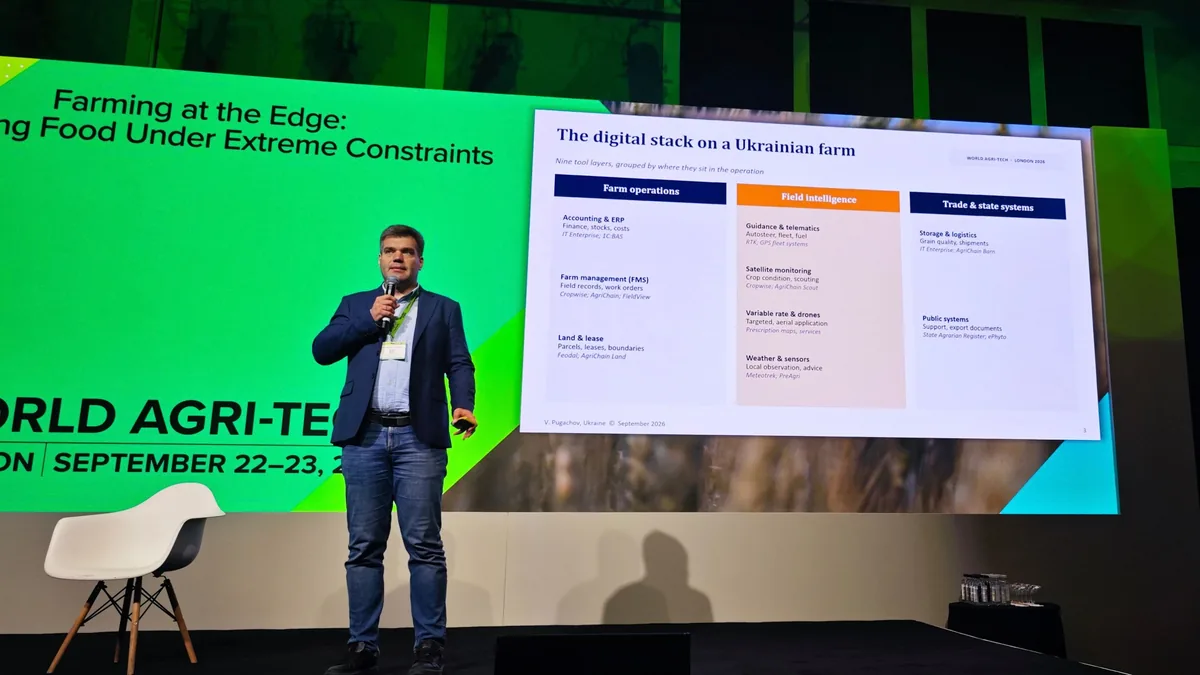
With natural disasters and wars, resilience now means working offline. In Ukraine, farm tools must run without GPS or internet, and mapping mines on fields is a digital priority.
It also matters for rural areas where connectivity is poor (thanks, Starlink, but it's a pretty expensive magic wand that many farmers can't afford).
Food security = national security.
Bonus: farmers want insight, not more data 🤔
I met an amazing farmer who told me they have terabytes of data collected by tractors in their fields and don't know what to do with it.
Dyson Farming has collected almost 2 billion data points in five years.
Feels like data collection is solved. Next: quality and actions.
So, what is actually slowing agritech down?
It's clear that with the power of AI + tech today, invention is not the problem. Data is not an issue either.
Adoption is. Trials, regulation, finance and trust.
By the way, AI in agriculture was Day 2.
Jane Byrne, Alexia Calles, Waveney Metcalfe — great job 🌟🌱🚀