AI fluency for the people who grow, process and feed the world.
Practical AI literacy training for agricultural and agrifood organisations. From a one-hour lecture to a fully customised course, your team learns what AI can really do in the field, the lab and the supply chain, and how to use it with confidence.
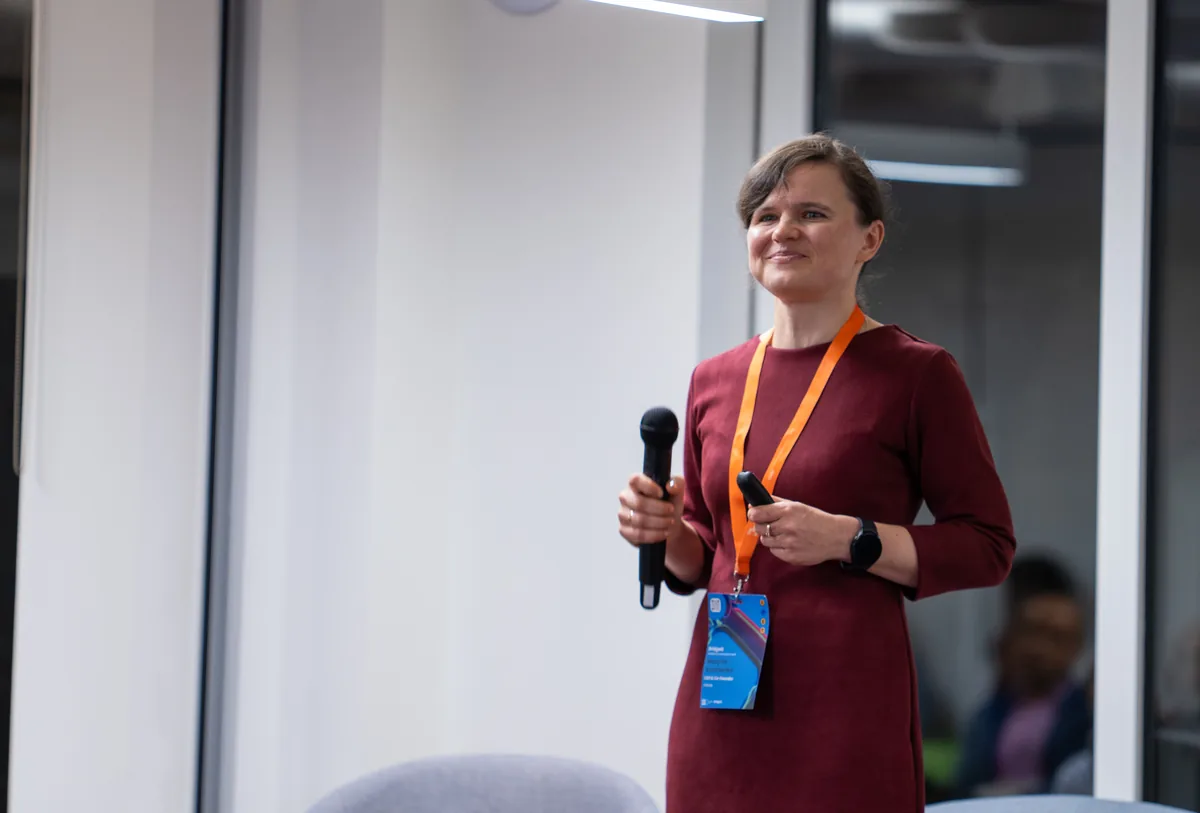
Delivered by me, Dr. Maryna Kuzmenko: agri-AI founder, researcher and educator. Online or on site, across the UK and internationally.
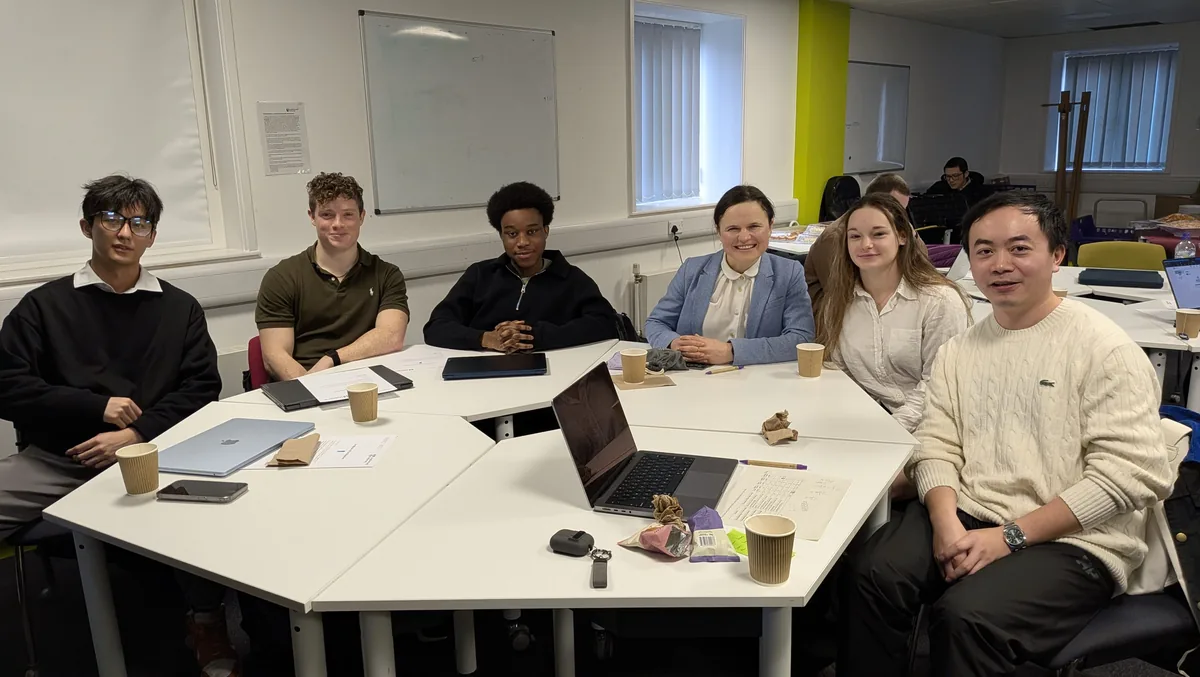
- 45 min to 12 weeksFrom a keynote to a full course
- Online or on siteLive, in person, or both at once
- 5 to several hundredWorkshops of up to 25 per group
- No coding neededAdvanced tracks if you want them
AI is already in your sector. Is your team ready for it?
Computer vision counts fruit and measures leaves. Sensors and models predict yield, disease and milk output. Language tools draft reports, grant bids and supplier emails in seconds. Your competitors, customers and funders are already asking how you use AI.
Yet most teams were never taught what AI actually is, where it works and where it fails. That gap leads to two costly mistakes: ignoring tools that could save hours every week, or buying expensive solutions that never fit the farm, the lab or the data.
AI literacy for agrifood is the ability to understand, use and critically evaluate AI tools in farming, agronomy, food manufacturing and supply chains, and to use them responsibly. It sits between AI awareness (knowing what AI is and its risks) and AI fluency (confidently applying AI to solve new problems).
- Make better decisions about AI tools, vendors and pilots
- Work faster with everyday AI assistants, safely and responsibly
- Collect better data today, so AI projects succeed tomorrow
- Speak the same language across agronomy, operations, R&D and leadership
Built for agriculture and agrifood teams
Farms and growers
Managers, agronomists and technical staff who want to use AI on the ground.
Food producers, packers and retailers
Operations, quality, supply chain and sustainability teams.
Agritech companies
Sales, product and customer success teams who need to explain AI clearly to farmers.
Research institutes and universities
Scientists, PhD students and technicians in plant science, phenotyping and animal science.
Industry bodies, cooperatives and advisers
Consultants, extension officers and member organisations.
Leadership teams and boards
Executives who need a clear, honest picture of AI's risks and opportunities.
No coding or technical background is needed, unless you ask for an advanced track.
From a single talk to a full programme
Every format can be delivered online or in person, for groups of any size.
| Format | Length | Best for |
|---|---|---|
| Lecture or keynote | 45–90 minutes | Conferences, staff days, board meetings and kick-offs. Clear, and grounded in real examples. |
| Short lesson | 1–2 hours | Lunch-and-learns and team briefings on one focused topic. |
| Half-day or full-day workshop | 3–7 hours | Hands-on practice with real tools, your own data and your own use cases. |
| Multi-session course | 4–12 weeks, weekly or fortnightly | Building lasting AI fluency across a team or department, with exercises between sessions. |
| Custom programme | Designed with you | A learning pathway mixing lectures, workshops and follow-up support, built around your crops, livestock, products and goals. |
Add to any format
What your team can learn
Each topic works as a stand-alone lecture, a workshop or a module in a longer course. Mix and match them into your own programme.
AI fluency foundations: AI literacy for every employee
What AI is and isn't, and how machine learning, computer vision and large language models work, in plain language. Myths, limits and risks, and how to judge AI claims from vendors and the media.
AI in agriculture
How AI is used on real farms today: crop monitoring, yield prediction, disease and pest detection, precision spraying, livestock and dairy monitoring, and decision support tools. What works, what is still hype, and how to start a pilot.
AI in agrifood
AI across the food chain: forecasting demand, quality inspection, traceability, food safety, waste reduction, packing and logistics, and sustainability reporting.
AI in plant phenotyping
Image-based measurement of plants: leaf area, growth, and stress and disease scoring. Cameras, calibration, and detection and segmentation models explained, with real examples from research and commercial growing.
Data collection basics for the future of AI
AI is only as good as its data. How to collect, label, store and share field, lab and farm data so it is ready for AI: images, sensor readings, records, metadata and data quality. Best taken before any AI project starts.
Basics of robotics and AI in agriculture
How agricultural robots see, decide and act: harvesting, weeding, milking and autonomous vehicles. Sensors, navigation, safety and costs, and what robotics means for farm labour and skills.
Generative AI and prompting at work
Hands-on use of AI assistants for everyday tasks: reports, emails, grant applications, technical summaries, research reviews and training materials. Prompt engineering basics, with examples from agriculture.
Responsible AI: data, privacy and trust
Who owns farm data, the basics of GDPR, bias and transparency, and writing an AI use policy for your organisation.
AI strategy for leaders
A briefing for executives and boards: where AI creates value in your business, how to assess vendors and pilots, what skills your teams need, and how to measure the return.
Don't see your topic?
I can build a course around your own crop, livestock, product, process or research area.
From first email to confident team in four steps
-
Get in touch
Send a few lines through the contact form about your organisation, your team and what you would like to achieve.
-
Discovery call
A short call to understand your sector, your team's current AI skills and your goals, with an optional skills survey for participants.
-
Tailored proposal
A clear outline of the format, topics, schedule, delivery and price, with examples adapted to your crops, livestock, products or research.
-
Delivery and follow-up
Practical sessions online or on site, with materials your team keeps, and follow-up support to turn what they learned into action.
Learn from someone who builds AI for agriculture
I'm a scientist, founder and educator working where AI meets agriculture, with nearly ten years of applying digital technology to farming. I co-founded Petiole, a UK agritech company that uses computer vision to measure plants in the field and the lab, and has won three Innovate UK grants and one Horizon Europe grant for practical AI in agriculture. I also founded MooMore, which uses AI thermal imaging to detect lameness early in dairy cattle.
I turn complex technology into clear, practical language that farmers, food businesses and scientists can use straight away. I:
- Host a weekly Friday LinkedIn Live on understanding agricultural AI — watch the recordings ↗
- Write the AI in Agriculture newsletter for 16K+ readers — read the archive ↗
- Created the course AI in Agriculture: Practical Introductory Course ↗, taken by 3.4K+ students in 129 countries
- Speak at industry events and give corporate keynotes — speaking
- Innovate UK Women in Innovation Award 2025/26 — Winner, for MooMore, AI thermal imaging for early lameness detection in dairy cattle.
- Oxford Farming Conference Inspire Fellow 2026 — one of 15 in the cohort.
- LinkedIn Top Voice — named in May 2026.
Because I build real AI systems for agriculture, every session is grounded in what actually works on farms and in labs, not in theory or sales talk. The full story is on the About page.
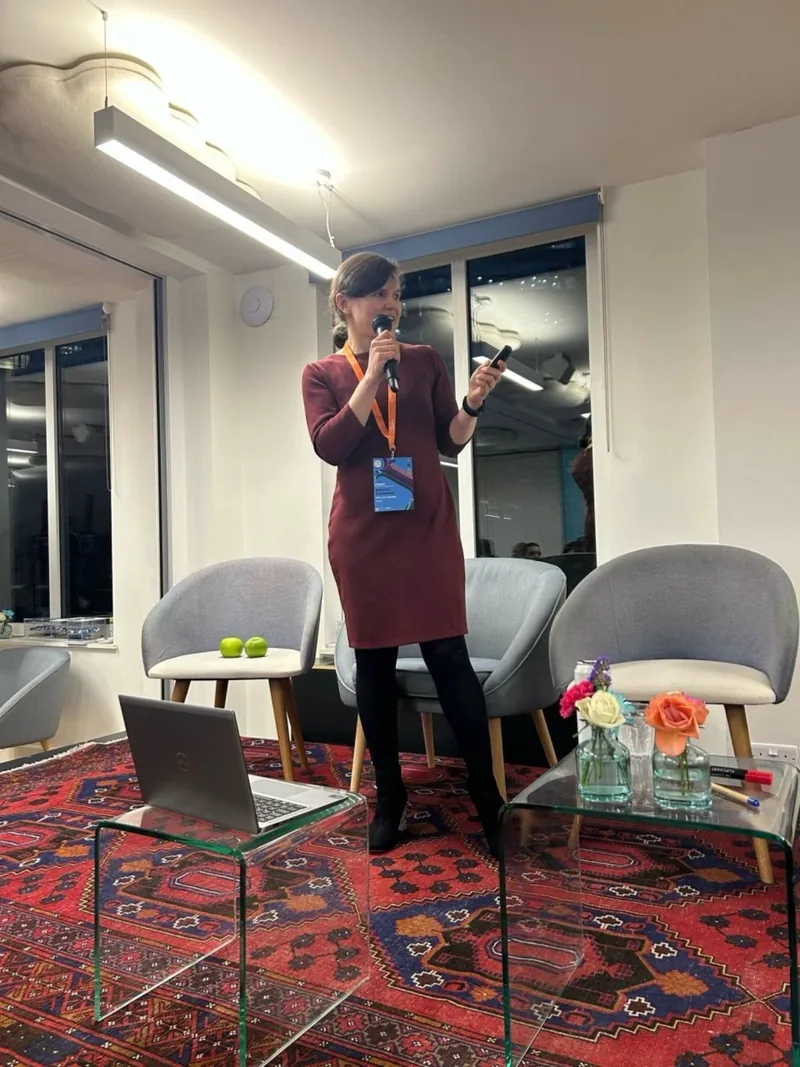
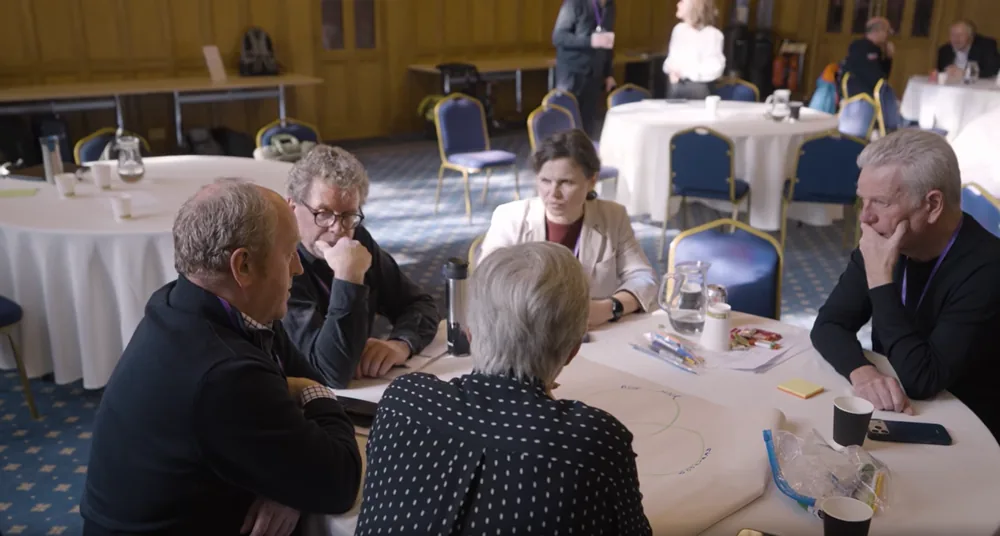
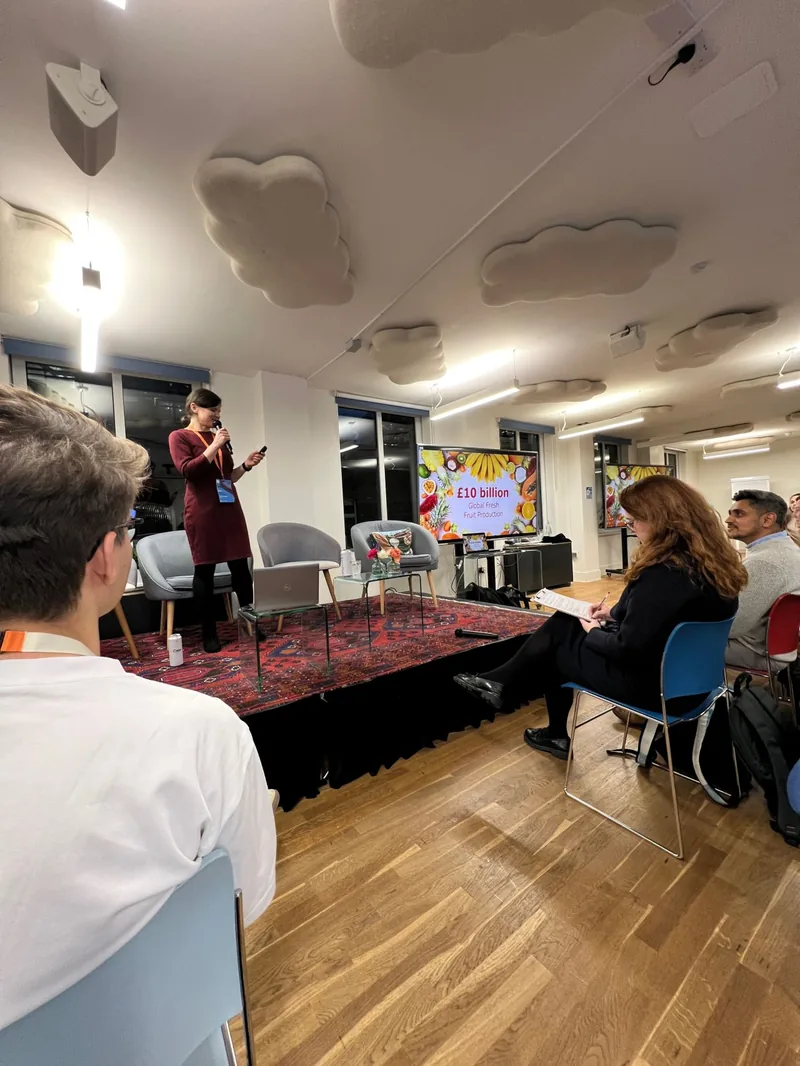
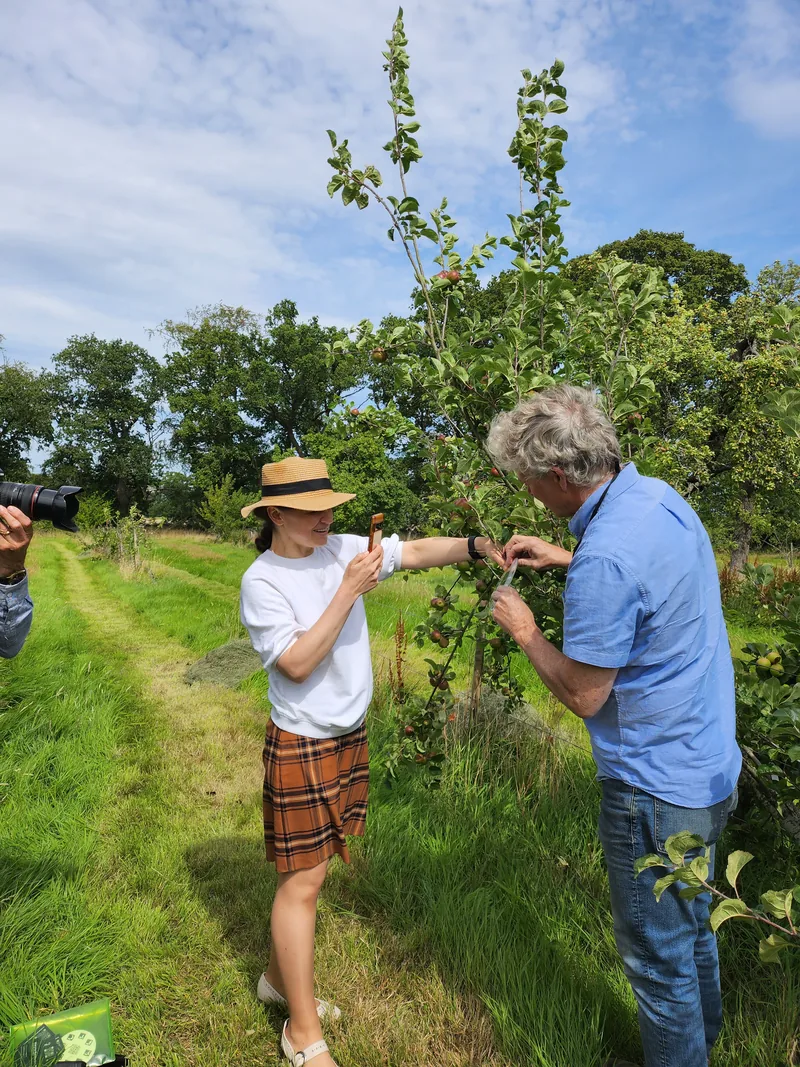
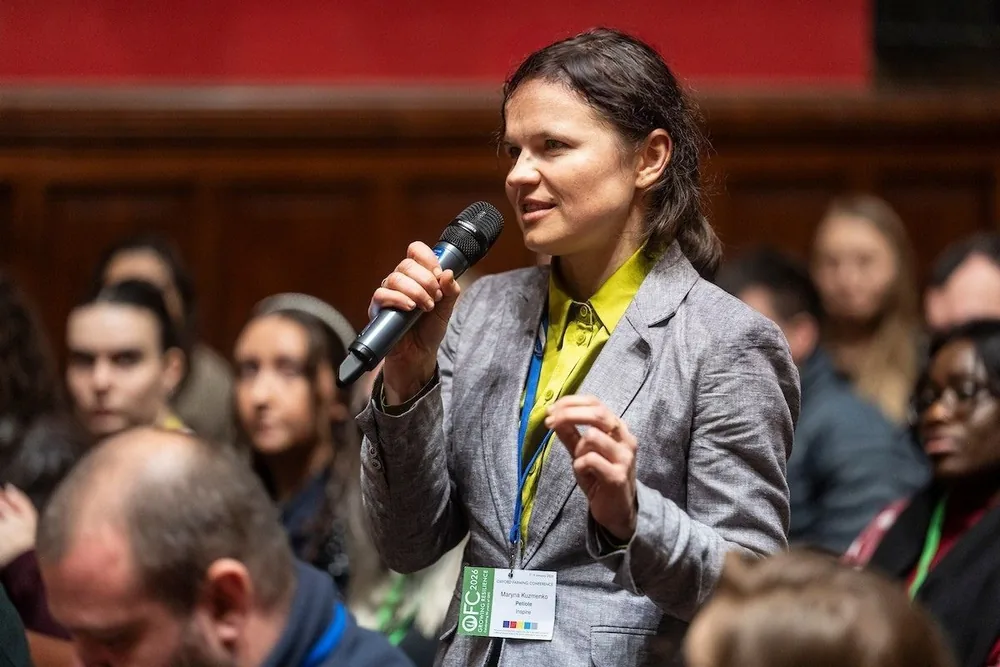
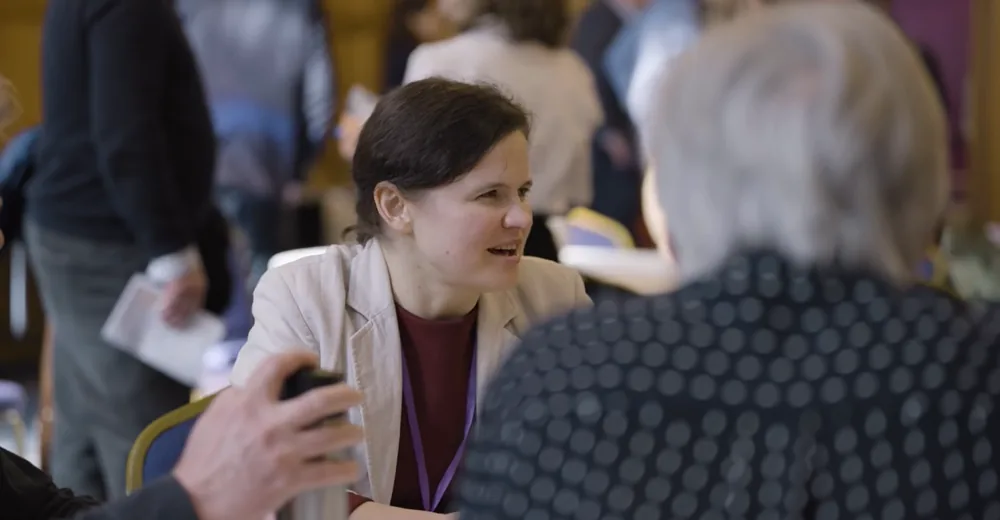
From the conference hall to the orchard
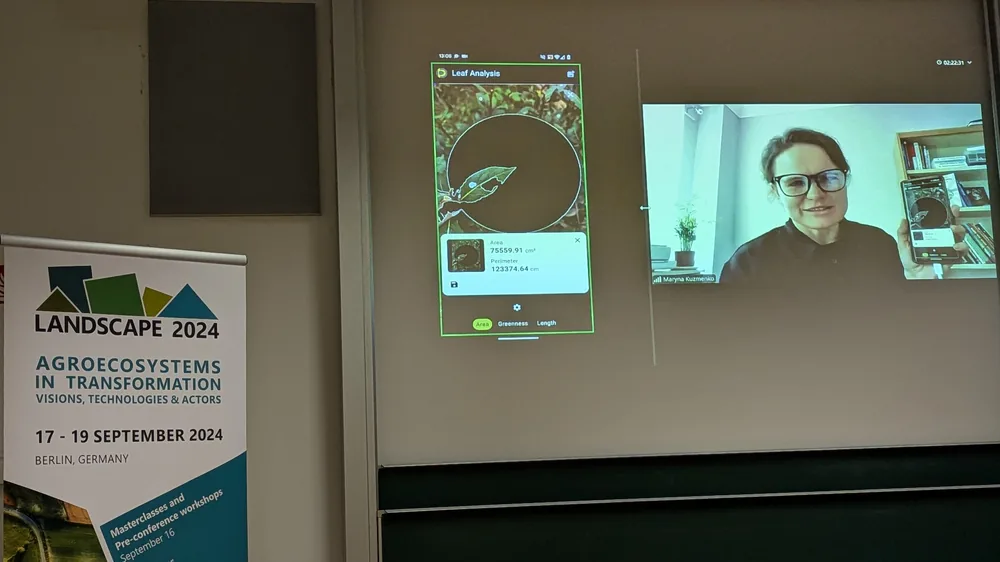
Talks, round tables and conversations in the field, in person and online.

Real skills, not just slides
After the training, participants can:
- Explain in plain words how AI works and where it fits in agriculture and agrifood
- Spot realistic AI opportunities in their own role and business
- Ask the right questions of AI vendors, consultants and data partners
- Use AI assistants safely and productively in everyday work
- Collect and organise data that is ready for future AI projects
- Understand the risks: data privacy, bias, errors and over-reliance
- Take part confidently in AI pilots, grant projects and digital transformation plans
Free for everyone on your team, today
Courses your people can take on their own, at their own pace, before or after the training. Both are on aiinagriculture.org.
AI in Agriculture: Practical Introductory Course
15 video lessons (1h 14m), 8 marked quizzes, and a certificate of completion anyone can verify. No technical background needed.
3.4K+ students and a 4.4★ rating from 660 ratings on the course's Udemy listing — it is moving to aiinagriculture.org from there.
AI Fluency in Agriculture
A practical course series on briefing AI well, starting with Prompt Engineering Basics: no code, no jargon, with tomatoes, trial plots and farm shops as the examples all the way through.
Support your EU AI Act AI-literacy duty
Article 4 of the EU AI Act requires organisations that provide or use AI systems to take measures to support their staff's AI literacy. It has applied since 2 February 2025. An amendment in force since 27 July 2026 kept the duty, but no longer requires any particular level of AI literacy to be reached.
The Act does not name a course, and the European Commission's guidance says there is no need for a certificate: an internal record of training is enough. Training is one measure an organisation can take; on its own, it does not make an organisation compliant. National market surveillance authorities supervise Article 4 from 2 August 2026.
Sources: Regulation (EU) 2024/1689, the AI Act, Articles 2 and 4; Regulation (EU) 2026/1744, the Digital Omnibus on AI, in force from 27 July 2026; European Commission, AI literacy: questions and answers, updated 27 July 2026. This is a summary, not legal advice. Last reviewed .
Where UK workers are starting from
-
10 million
UK workers the government and its industry partners aim to give AI skills by 2030, through the free AI Skills Boost programme.
-
21%
of UK adults in work said they felt confident using AI tools at work, in an Ipsos survey for the government carried out in early 2024.
DSIT and DCMS, AI Skills for Life and Work, published 28 January 2026
Frequently asked questions
Do participants need technical or coding skills?
No. Most sessions are designed for non-technical staff. Advanced, hands-on tracks are available for data, R&D and engineering teams.
Can training be delivered online?
Yes. Sessions run live online, in person at your site, or as a hybrid. Recordings can be provided on request.
How many people can attend?
From small teams of 5 to audiences of several hundred. Workshops work best with up to 25 participants per group.
Can you adapt the content to our business?
Yes. Every course uses examples from your sector, whether that is arable, horticulture, dairy, food processing, retail or research. Custom programmes are built around your own goals and data.
Do you offer training in other languages?
I speak English, Ukrainian and Russian, and German at B1. I'm not fluent in Spanish, but I can prepare Spanish-language training, particularly in a video-on-demand format.
How much does it cost?
The pricing depends on the format, the length, the size of the group and how much is customised. Send me a few lines and I'll reply with a tailored quote within two working days.
Can our team earn CPD points?
Yes, from my workshops. CPD, continuing professional development, is the learning professionals keep up and record each year to stay current in their field, and schemes such as the BASIS Professional Register count it in points. Petiole Ltd, my company, is an official CPD provider registered with BASIS, so a workshop can provide an official CPD record for each attendee. Mention it when you ask for a quote.
Can this support funded projects or skills budgets?
AI literacy training can often be included in innovation projects, staff development plans and skills programmes. Get in touch to discuss your situation.
Do participants get a certificate?
On request, each participant can receive a certificate of attendance for a session, which records that they took part. It is a different document from the certificate of completion that my free AI awareness course on aiinagriculture.org issues: that one is earned by watching the course and passing its quizzes, and anyone can verify it there.
Is the training accredited?
If you need it, CPD hours can be obtained for a training built for you: Petiole Ltd is a CPD provider registered with BASIS.
What is the difference between AI awareness, AI literacy and AI fluency?
AI awareness means knowing what AI is, what it can and cannot do, and where its risks lie. AI literacy means using and evaluating AI tools responsibly in your own work. AI fluency means confidently applying AI to new problems and to the way work gets done.
Does the EU AI Act apply to UK agrifood companies?
It can. The Act applies to providers that place AI systems on the EU market wherever they are based, and to providers and deployers outside the EU whose AI systems produce output used in the EU. Whether that includes your business depends on where your AI systems and their output are used, so take legal advice for your own situation.
Does the EU AI Act require a certificate of AI literacy training?
No. Article 4 asks organisations to take measures to support their staff's AI literacy, and the European Commission's guidance says no certificate is needed: an internal record of training is enough. A certificate of completion can be part of that record, but it does not show that an organisation is compliant.
Is the AI awareness course really free?
Yes: all 15 video lessons, the quizzes and the certificate of completion, for every person on your team. Enroll here ↗
Ready to build your team's AI skills?
Tell me about your organisation and what you would like your team to learn, and I'll send a tailored proposal for a lecture, a workshop or a custom programme. Online and on-site delivery across the UK and internationally.
Contact MarynaI reply within two working days.